Essays

Pax Sinica?

The double-edged sword of Chinese investment abroad – by Jacob Dreyer

During the 19th Party Congress last week, Xi Jinping announced a new era of Chinese power. “Our country is approaching the center of the world stage,” he said in his opening remarks on Wednesday 18th, “and making continuous contributions to humankind.” Even those of us who feel qualms about this coming to pass can understand the material reasons why peoples all around the world, from European dockworkers to Zambian miners, are daring to hope for a benign Chinese hegemony. From the Hinkley Point power plant to the new Foxconn plant in Wisconsin, from high-speed rail in Ethiopia to a new hospital in Minsk, Chinese investment around the world holds out the possibility for improved health, electricity networks, transportation and stable employment for people all around the world.
Essays

Exhibition as Theater

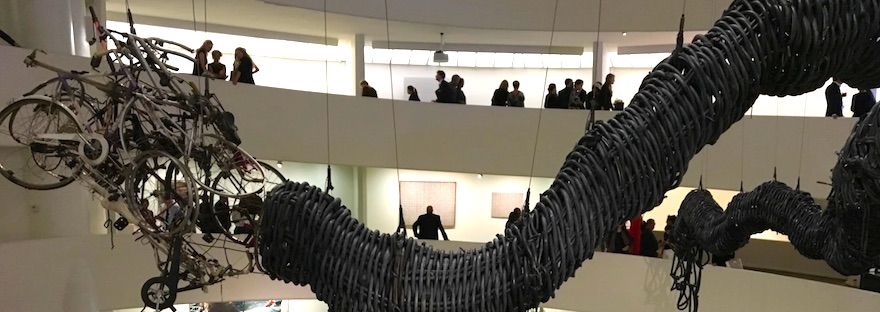
Denise Y. Ho on Art and China After 1989 at the Guggenheim

The first time I saw Ai Weiwei’s art, I was appalled. Almost twenty years ago, long before he became an internationally-known contemporary artist, one of my Chinese-language classmates at Qinghua University brought me to Ai’s studio on the outskirts of Beijing. What I saw that afternoon remains imprinted in my mind’s eye: photographs of him giving the middle finger to monumental buildings, rows of ancient pottery casually whitewashed, and elegant Ming dynasty tables sawed in half and reattached at bizarre angles. It was not irreverence to power that bothered me; it was those last two artworks. Never having taken an art history course, and never having heard of the “readymade”, I was horrified that someone could take antiquities and destroy them.  Years later, as a graduate student in Chinese history, I researched and wrote about the idea of “cultural relics”. To this day, my seminar students at Yale take one session to debate the question of who owns art and artifacts.

Essays

The Party is Just Getting Started

Notes on the Nineteenth Party Congress – by Jude Blanchette

In August 1980, Deng Xiaoping, China’s paramount leader until his death in 1997, addressed an enlarged session of the Political Bureau (Politburo) of the Chinese Communist Party’s (CCP) Central Committee. Having just emerged from the wreckage of the ten-year Cultural Revolution in 1976, China was plagued with what the Party’s aging Marxist revolutionaries liked to call “contradictions.”

For Deng, four such challenges confronted the Party and the political system it dominated:

Essays

Russia and China’s Diplomatic Dance

The Russian ballet that offended Mao and harbingered the Sino-Soviet Split – by Eveline Chao

On June 30, China’s state-owned paper People’s Daily declared “China-Russia ties better than ever in history”. A few days later, Xi Jinping reiterated the sentiment during a state visit to Russia. While rhetoric never quite reflects truth, it’s certainly a major leap forward from 1969, when the two nations spent seven months in undeclared military conflict over their shared border, during the height of the Sino-Soviet split.

Unsurprisingly for two enormous and ambitious countries, relations between the two have always been touchy. One the one hand, they have been brought together by common concerns: fighting in the Korean War, countering the United States, and, more recently, keeping North Korea in check. On the other hand, they are also rivals: they have fought often for control of Mongolia and Manchuria, and each nurtures a vision of former glory that, if restored by one, could put the other at a disadvantage. Each country’s fate impacts the other’s.

Essays

The Afterlife of Lu Xun

How the man became the brand, both political and commercial – by Julia Lovell

On 19 October 1936, Lu Xun died of tuberculosis in Shanghai, still mired in quarrels with the leadership of the League of Left-wing Writers, and especially with Zhou Yang, the literary politico who would become Mao’s cultural tsar after 1949. “Hold the funeral quickly,” he set out in a mock testament written a month before his death. “Do not stage any memorial services. Forget about me, and care about your own life – you’re a fool if you don’t.” And finally, a message for his son: “On no account let him become a good-for-nothing writer or artist.”