Essays

Why Xi Jinping’s China is Legalist, Not Confucian

The philosophical basis of China’s “New Era” – Sam Crane

Jiang Shigong, a law professor at Peking University, thinks Xi Jinping is the epitome of the new Confucian-Marxist leader. In a recent article – an explication of Xi’s speech at the 19th Party Congress last October – Jiang takes the edge off of Xi’s Leninism by making numerous passing references to a variety of classical Chinese philosophical concepts, including “the unity of heaven and man” (天人合一); “Learning of the Heart” (心学); and “when the Way prevails, the world is shared by all” (大道之行, 天下为公), among others.

However, just like Xi, Jiang largely ignores the Legalist tradition of Chinese thought, which arguably has much greater relevance to the current emphasis on Party building and political centralization in the People’s Republic of China.
Essays

Elixirs of Nature

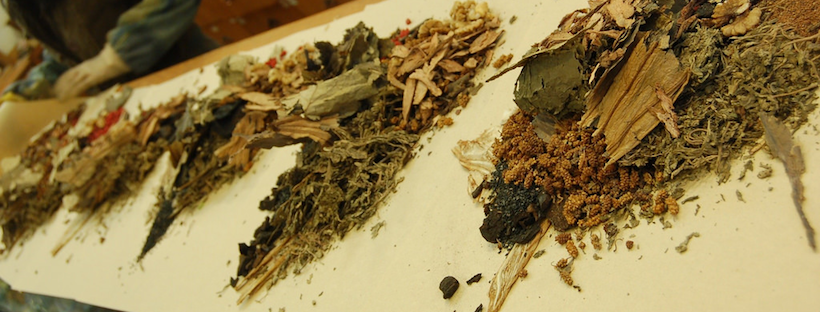
How Chinese medicine uses the potency of herbs – Dustin Grinnell

In 221 BC, Qin Shi Huang became the first emperor of China after conquering the warring states and unifying an immense territory. A leader of colossal vision, Qin oversaw the building of the Great Wall, constructed a national road system and standardized China’s currency. To protect him in the afterlife, the emperor spent almost forty years building a mausoleum in his imperial city of Chang’an in central China, guarded by the Terracotta army.

Obsessed with immortality, Qin commissioned alchemists to scour the country in search of an “elixir of life,” a concoction that would cure all diseases and stave off death. These alchemists brought back plants, minerals, animals, insects and metals from every corner of China. After repeatedly ingesting small silver balls of mercury, a highly poisonous metal, the emperor grew increasingly ill. On a tour of eastern China, he died of mercury poisoning, killed by the very elixir he had hoped would grant him eternal life.

Essays

Redeeming Empress Gi

The Korean woman who once ruled China – Joan MacDonald

In the year 1331, the 16-year-old girl who would one day become Empress Gi arrived in the Yuan capital of Khanbaliq (present-day Beijing) among hundreds of young men and women sent as human tributes from Korea. She was offered to the royal court along with flocks of hunting falcons, quantities of ginseng, hanji paper, and baskets of silver and gold ingots.

It’s hard to imagine that she was happy to leave her homeland for an uncertain future, but the well-educated, resilient Lady Gi was determined to survive. She eventually became the first  Korean empress of the Yuan Dynasty and effectively came to rule the 60 million inhabitants of Mongol-controlled China in that dynasty’s waning years.

Yet many of Gi’s accomplishments were ignored because her history was written by those who defeated her. She was labelled a traitor in Korea and demeaned as a corrupting influence by Ming Dynasty historians. When her life was dramatized in the Korean television series Empress Ki, viewers criticized the portrayal as too sympathetic. Historians who came to her defense suggested that her alleged treason might more accurately be viewed as the fulfillment of filial duty. It’s time to rethink the role history assigned her.

Essays

The Shanghai Mind

Arthur Ransome and the Origin of the Shanghai Mind – Paul French

People have long talked about Shanghai being different from the rest of China. Beijing scholars in the 1920s coined the term haipai (Shanghai style) to criticize Shanghai’s self-obsessive modernity. Shanghai was a “bubble,” “a bastard child,” somehow not fully China.

It is true that Shanghai’s history is distinctly different to that of other Chinese cities. It was not a Crown Colony, a Dominion, a Commonwealth, a Raj or a Federated State, but Shanghai was that other product of British imperialism – a Treaty Port. From 1842 until 1941, Shanghai was one of initially five settlements forced from China after the First Opium War (1839-1842) and based on the notion of extraterritoriality, which meant that foreigners were exempted from the jurisdiction of local Chinese law.

Essays

A Date To Forget

Doubling down on the Tiananmen taboo – Louisa Lim

To write my book The People’s Republic of Amnesia: Tiananmen Revisited, I spent a lot of time in fast-food restaurants. Not because I like burgers, but because dissidents often favour the crush of diners and the buzz of conversation, believing it complicates surveillance. As I sat in McDonald’s with Bao Tong – who spent seven years in jail as the highest government official to be sentenced post-Tiananmen – he could point out which plainclothes policemen were shadowing him. When I visited Zhang Xianling – who co-founded The Tiananmen Mothers, a group of relatives of those who died when the government troops crushed the democracy movement in Beijing on 4 June 1989 – her first words were: “They knew you were coming.” The police had already phoned her to ask the purpose of my visit, knowledge presumably gleaned from tapping her, or my, phone. The surveillance was explicit by design: an act of intimidation aimed at multiple audiences.