Essays

Disappeared Forever?

The persecution of Uighur intellectuals – Henryk Szadziewski

I was raised in the UK by parents who survived the Nazi occupation of Poland. I grew up hearing their stories of fear and deprivation. My father spent time in a German internment camp, with only threadbare clothes to protect him from the freezing cold. Decades later, even on mildly cold days, he would put several pairs of socks on his feet to keep the chill at bay. It was a persistent reminder of his severe experiences as a young man. I didn’t understand the lasting psychological and physical impacts of internment.

My parents were fortunate. They survived and rebuilt their lives. Members of their family and community, and millions of people in Poland including the educated elite, did not share this fate. In 1939, the Nazis implemented ‘Intelligenzaktion,’ a policy that singled out Poland’s intelligentsia. Selected people were targeted, disappeared and murdered. The aim was not only to ‘cleanse’ the newly conquered territory, but also to wipe out any source of opposition to Nazi rule. Professor Jan Pakulski writes that these ‘eliticides’ resulted in the “formation of a politically dependent and socially deracinated ‘quasi-elite’ with limited capacity for governing.”

Essays

Sartorial Sycophancy

What Venezuelan President Maduro wore in China – Frank Beyer

As Venezuela has been the recipient of over half of China’s loans to South America, the ongoing crisis there is of concern to Beijing. China continues to support the embattled government of Nicolás Maduro and, like Russia and Turkey, doesn’t recognize the opposition’s Juan Guaidó, who declared himself interim president in January 2019. Given that Venezuela is a major source of oil for China, the Communist Party would prefer stability and a continuation of the status quo. If the socialist revolución bolivariana started by Hugo Chávez and continued by Maduro does fall, however, the pragmatic Xi will be ready to negotiate with a new government. Guaidó, for his part, has said he wants a productive relationship with China. In light of the developing crisis, a look at Maduro’s wardrobe and actions on a trip to Beijing in 2018 gives us some insight into the relationship between the two regimes.

Essays

Reformist Propaganda

Yifu Dong visits Beijing’s new exhibit celebrating economic reform

Forty years ago, China’s leadership decided that the Chinese people deserved better than having to suffer from mass hunger, abject poverty and periodical chaos. It rolled out a program called Reform and Opening, setting China on a path of capitalist normalcy, or as most pundits put it, “an economic miracle.”

This past November, the National Museum of China, a sullen monolith hunching over the east side of Tiananmen Square, put on a grand exhibit called ‘The Great Transformation,’ which celebrates China’s progress in the past four decades. Before it opened on November 13, when President Xi Jinping visited, the National Museum closed for 50 days in preparation. Seeking earth-shattering revelations about Chinese politics from such a well-orchestrated propaganda exhibit is the same as digging for gold in a coal mine, but the basics of China’s new narrative about Reform and Opening are worthy of a recap.

Essays

Literary Heartthrobs

A centuries-old tradition of writers as sex symbols in China – Pamela Hunt

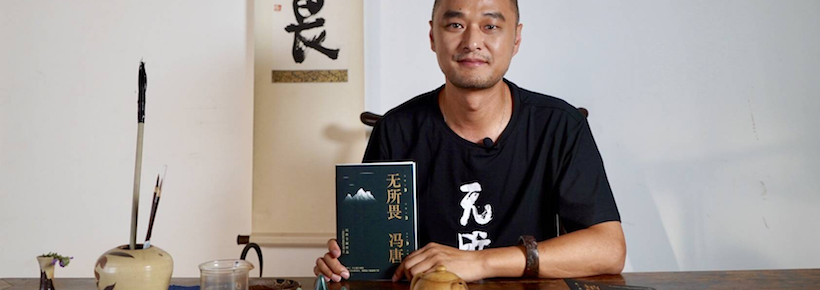
If you were so inclined to follow the Weibo account of Feng Tang, a Beijing-based writer, you might notice a reccuring meme. A fan – almost always a young, attractive female – will post a picture of herself holding a copy of one or more of Feng Tang's works. She will strike an appealing pose, maybe add a few hearts or kissing emojis, or even wish the author a happy Valentine's Day and refer to him as a “dream boy.” Feng then reposts the message on his own Weibo page, with a suggestive phrase such as “we are really enjoying ourselves tonight.”

There is something intriguing about this trend, not least because it is centered around an author and businessman in his late forties whose image does not quite match those of the singers, film stars or models who we might more readily expect to attract this kind of adulation.

Essays

China’s Middle-class Rebellion

What the comfortably-off have to protest about – Robert Foyle Hunwick

Park Avenue, central Beijing, is known for its luxurious serviced apartments, landscaped gardens and Western-style amenities, certainly not its dissident population. Yet, strolling past the compound one weekend, I was surprised to see a protest in progress.

A small group of around two dozen had assembled with signs and were milling around outside a locked shop, arguing with a harassed-looking man in the Chinese junior-management uniform of white shirt and belted black trousers. The cause of all the chaos: a swanky gym that had opened in the gated community a few months before, promising unparalleled 24-hour access to upscale fitness machines and personal trainers, had used a recent public holiday to sell all its equipment and, apparently, make off with everyone’s membership fees. Now a dispute was in full swing over who was going to take responsibility for this fiasco. The building management, who presumably had vetted the gym? The police? The residents?